Hex battlefields, not a square grid in disguise
Axial hex maps with real terrain: impassable rock, resource fields, and a camera framed once per map so you read the whole board instead of driving it.
Built in Unity · deterministic simulation
Hex-grid RTS · Command the hex. Break the line.
A tactical hex-grid RTS. HammerForce armour against The Awakened's adaptive swarm — harvested credits, a real tech tree, and a simulation that resolves the same way on every machine that runs it.
No public download yet. The client, the content pack and the multiplayer server are built in the open.
Counted from content pack modern-warfare v0.1.0 · 4 simulation ticks per second · fixed camera
The game
No feature list that outruns the build. Everything below is either running today or described as what it is.
Axial hex maps with real terrain: impassable rock, resource fields, and a camera framed once per map so you read the whole board instead of driving it.
HammerForce leans on armour, range and staying power. The Awakened trade hit points for speed, numbers and energy weapons. Both rosters come straight from the content pack.
The simulation core is pure C# with no engine types in it. The same inputs produce the same match on desktop, on the server and in a replay — which is what makes authoritative multiplayer and verifiable replays possible at all.
Units, buildings, weapons, armour classes, research, rules and maps are versioned JSON validated on load. Adding content is a file, not a code change.
The graph further down is generated from the same prerequisite and production fields the engine checks. There is no second, hand-drawn tree to fall out of sync.
Destroy the enemy headquarters, or hold the control areas until your strike charges. Same board, two clocks.
In the field
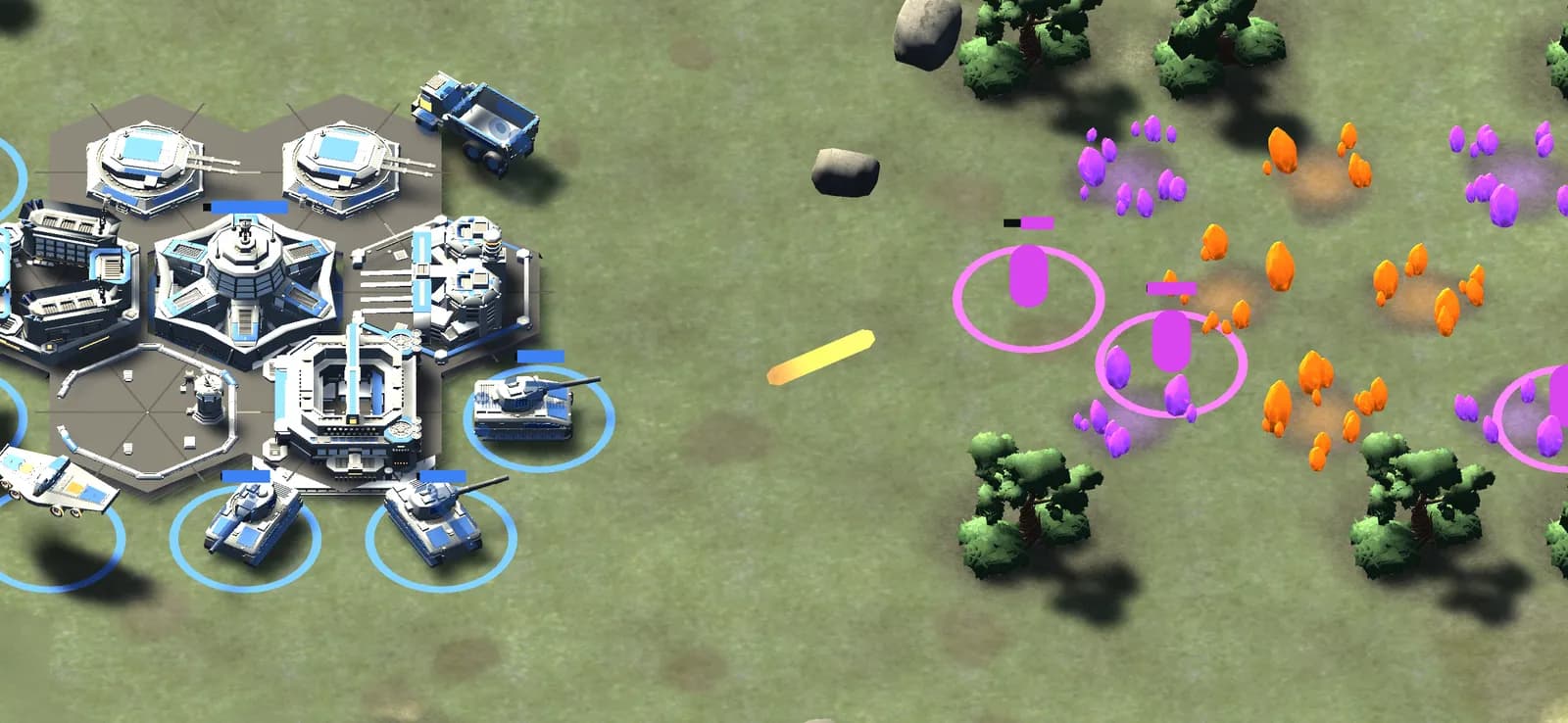
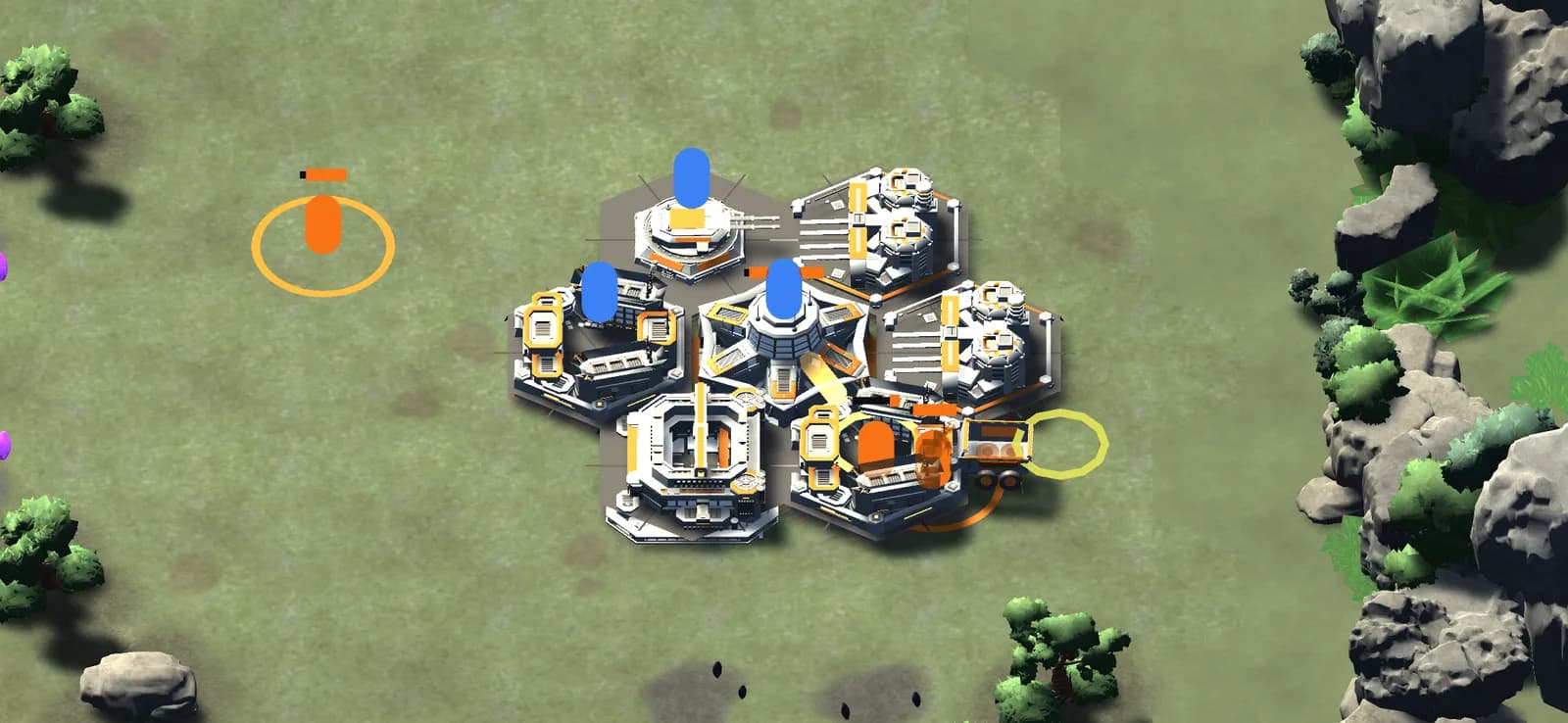
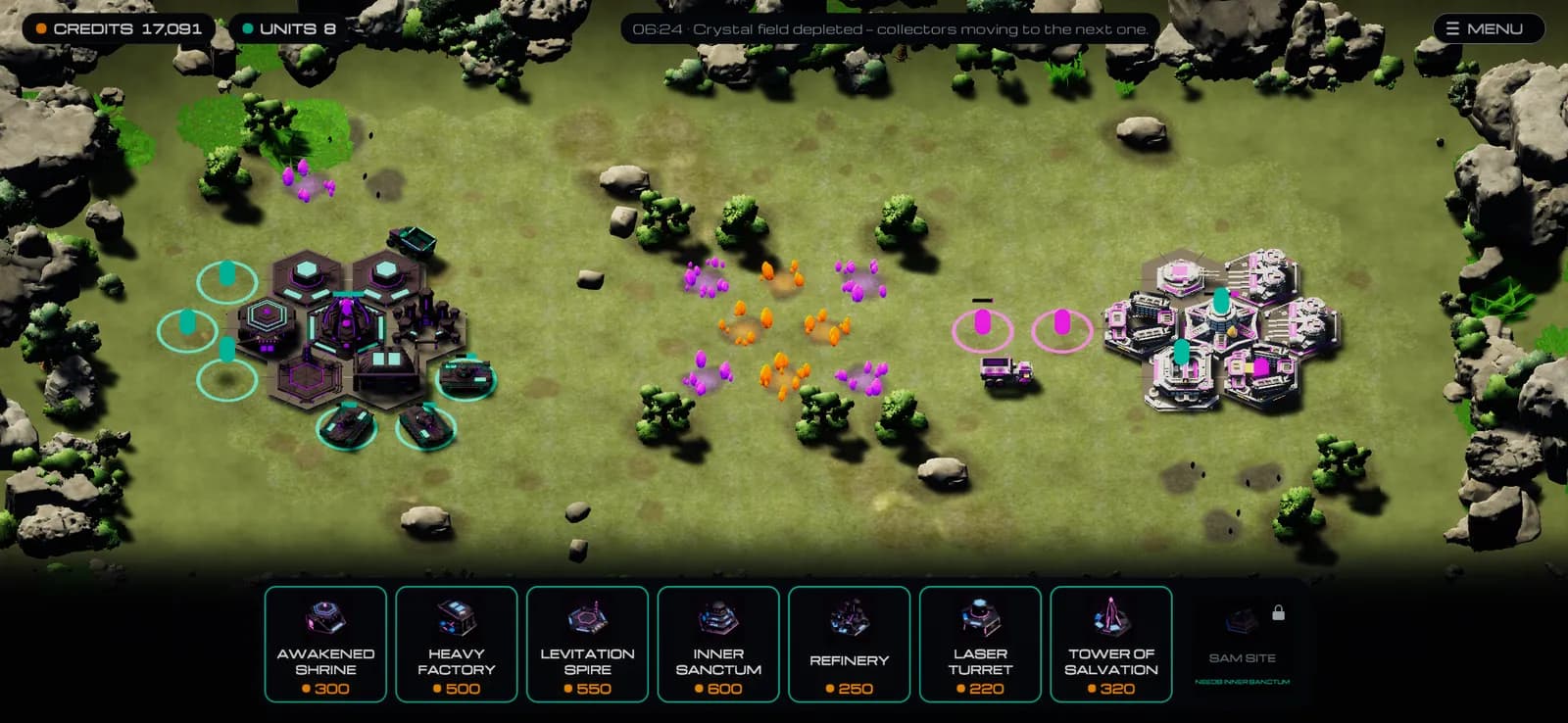
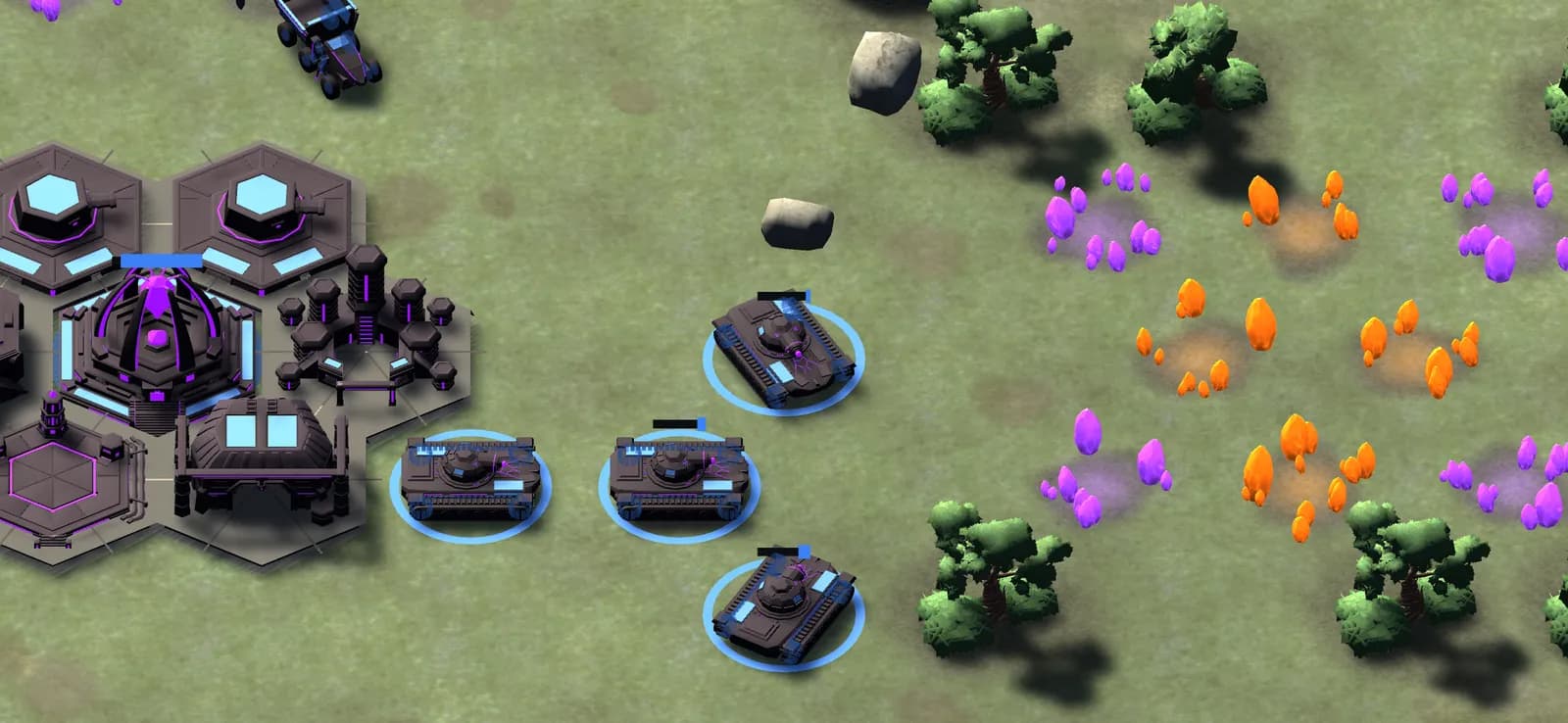
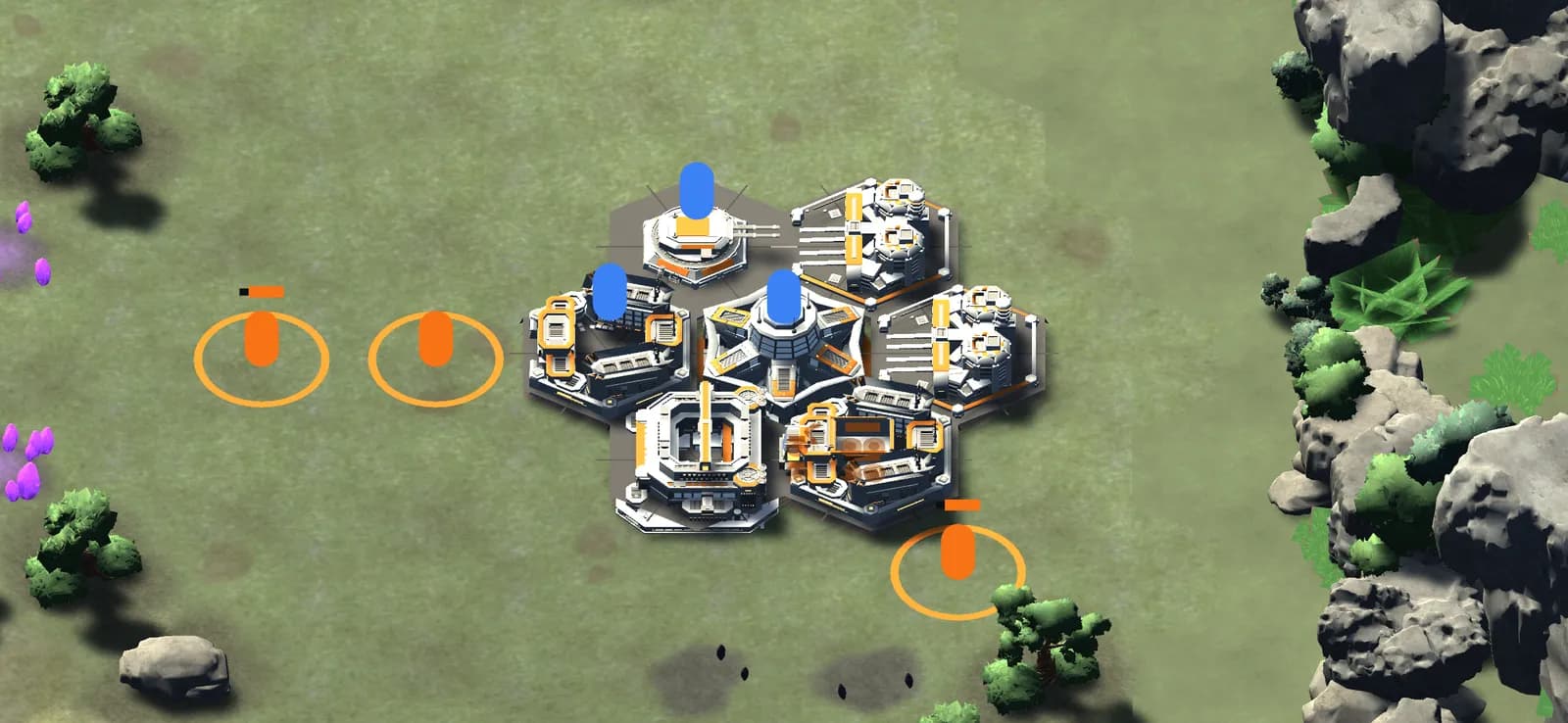
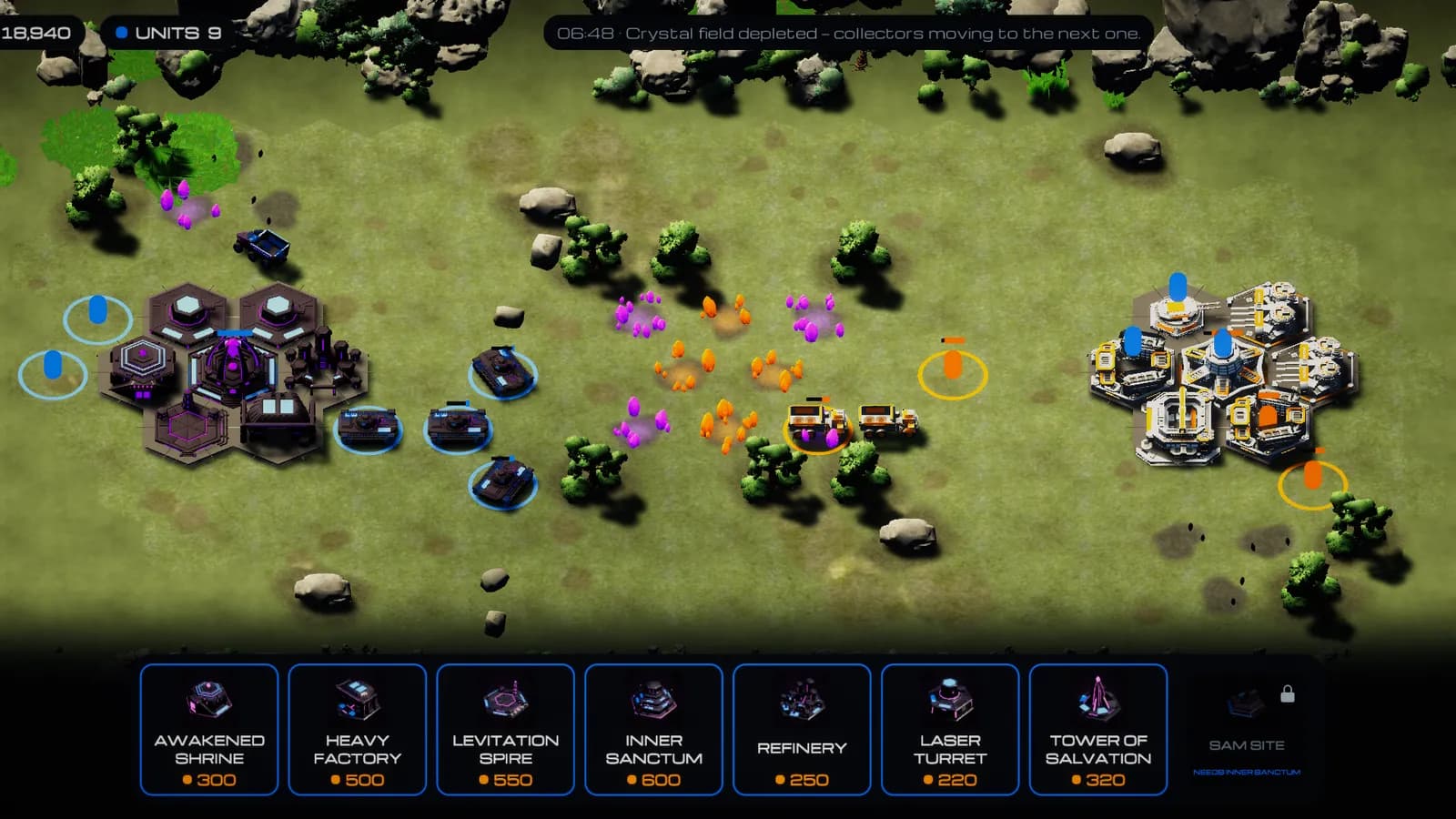
Real Unity Game View captures from local HARD-AI skirmishes on Grasslands. They are pre-alpha footage, not painted-over mock-ups.
How to play
Touch-first and single-select: one tap picks a unit, one tap gives it an order. No drag-boxes, no right click, no camera to wrestle.
Tap a unit or a building to select it — one at a time. Tap it again, or tap empty ground, to let it go.
With something selected, tap open ground to move there and tap an enemy to attack it. Units that cannot shoot simply move.
Collectors work resource hexes on their own and haul the load to a refinery. Without one the headquarters still accepts cargo — at a cut.
The headquarters raises your first structures; each one unlocks the next tier and its own production list. Queue units from the building that makes them.
The advanced lab converts credits into permanent upgrades — armour, damage, range, speed or cargo — for a whole unit class.
Level the enemy headquarters. In Nuclear Rivals you can get there with a strike instead, if you hold the control areas long enough.
Economy, in numbers
Resource fields differ in what they hold: valor 1,000, vector 500. One crystal is worth 20 credits.
Game modes
Both modes are fought on the same maps with the same economy. What changes is how the last building falls.
The straight duel. Out-harvest, out-build and out-fight your opponent, then bring the enemy HQ down. Sudden death can be armed for matches that refuse to end.
Control areas sit on the board. Hold a strict majority of them and your silo charges; lose it and the charge resets. A launch takes a fixed share of the enemy HQ's maximum health, so two clean strikes decide it.
Factions
Both sides harvest the same credits on the same hexes and win the same way. Everything between those two facts is different — and every figure below is averaged out of the shipped roster, not written by hand.
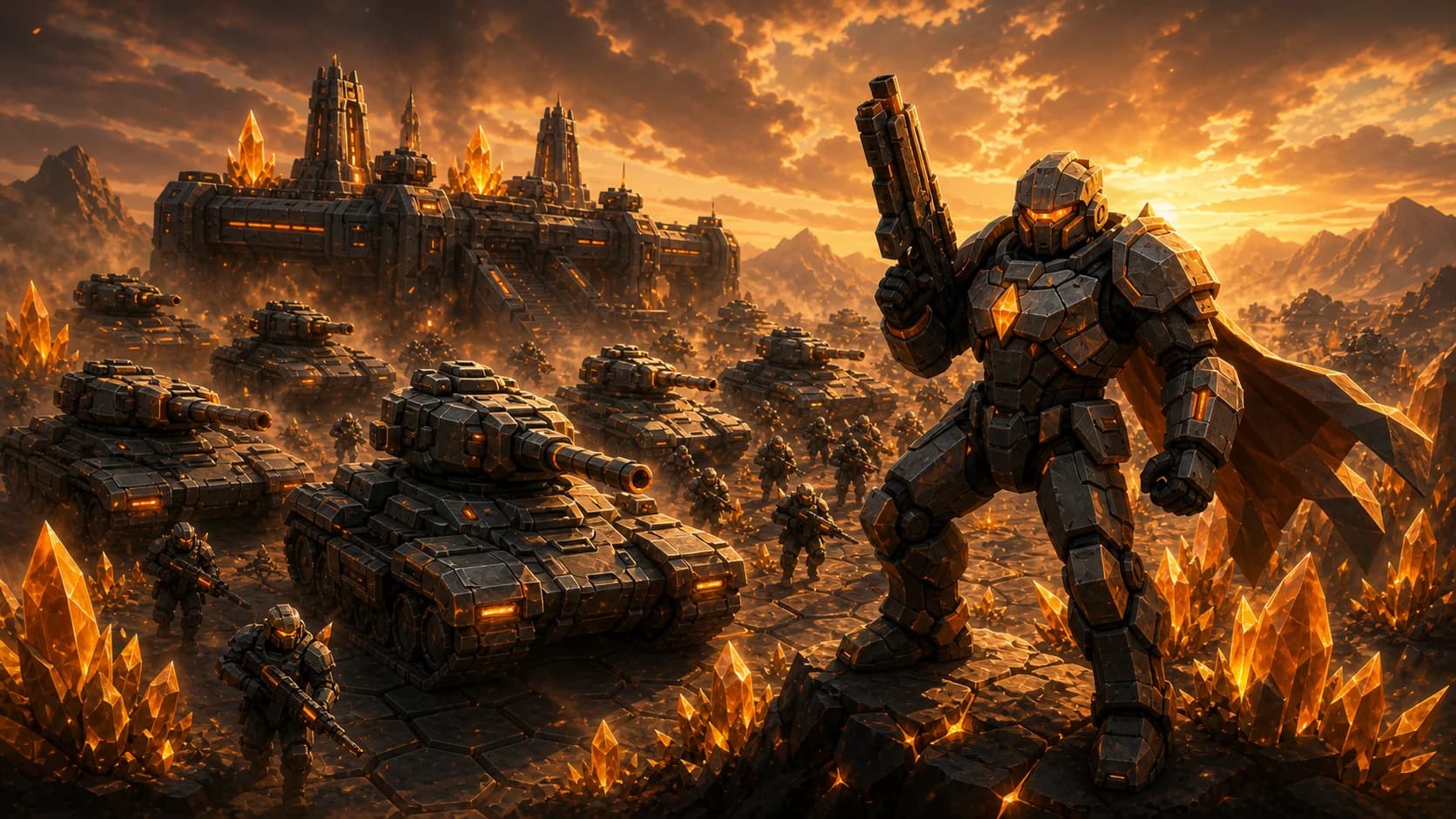

ARMOR. DISCIPLINE. FIREPOWER.
The conventional army answer: gunmetal plate, massed cannon and combined arms that hold a line. Rifle squads screen the armour, rocket teams punish anything tracked, and the advanced lab turns credits into permanent staying power. Nothing subtle — everything survivable.
Read left to right: finish the source before the target unlocks. Scroll sideways on a narrow screen. Costs in credits.
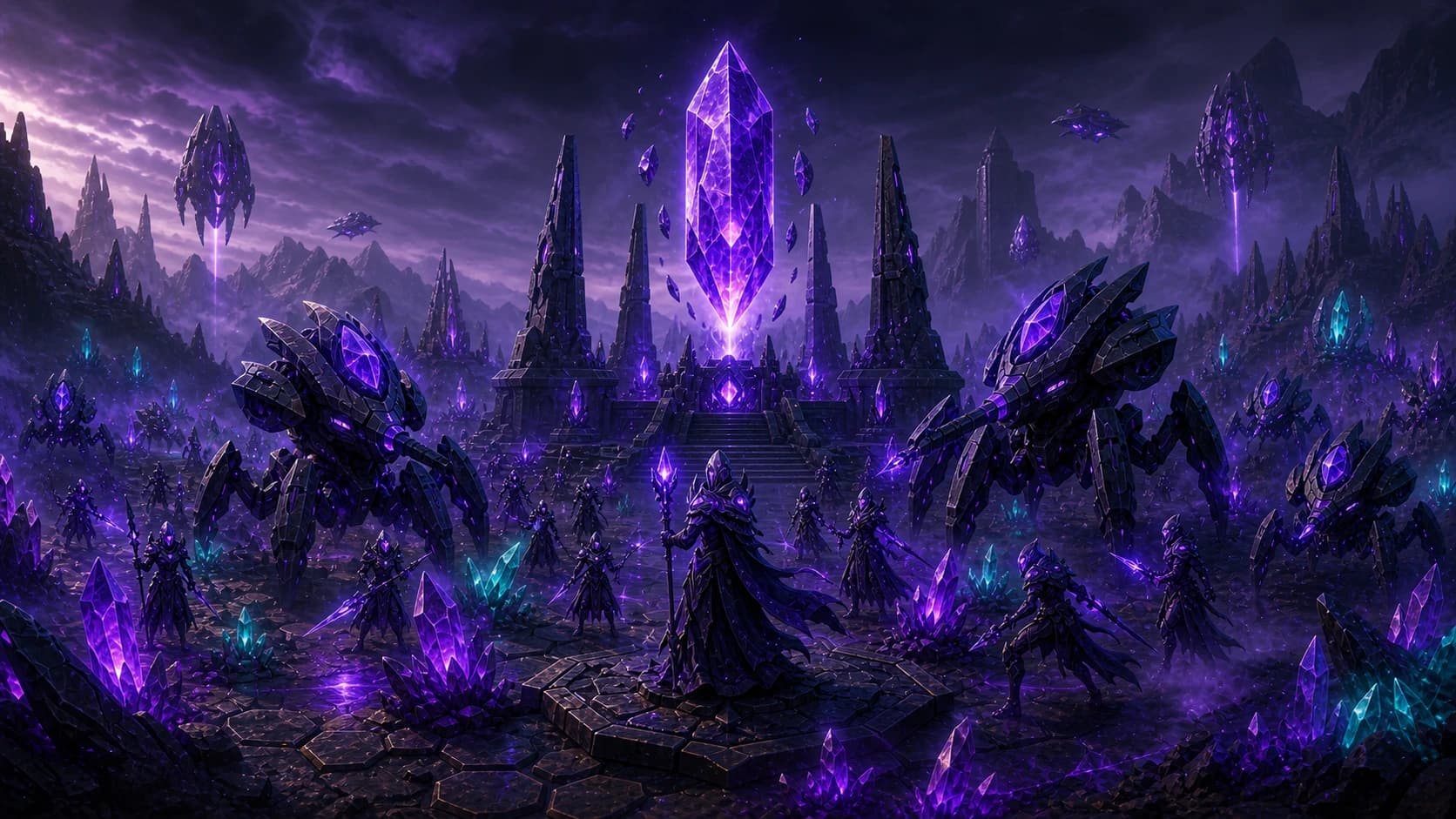

THE SIGNAL DOES NOT SLEEP.
A collective that trades armour for tempo. The Awakened field cheaper, faster chassis in greater numbers, lean on energy weapons that answer air and ground alike, and win the fights that start before the other side has finished deploying.
Read left to right: finish the source before the target unlocks. Scroll sideways on a narrow screen. Costs in credits.
Army
All 55 entries in the shipped content pack, with the values the simulation actually uses. Costs are credits, ranges are hexes, times are converted from ticks at the pack's own rate.
55 entries — 19 structure · 11 vehicle · 10 research · 8 aircraft · 7 infantry
+18% hit points (vehicle)
+22% damage (vehicle)
+15% hit points (buildings)
+50% range (infantry)
+30% cargo (harvester)
+20% hit points (infantry)
+25% damage (vehicle)
+35% damage (infantry)
+25% speed (vehicle)
+30% cargo (harvester)
Maps
The camera is framed once per map and never moves, so a map has to be readable in a single view — on a monitor and on a phone held sideways. Every count below is taken straight off the map's tile list.
Any biome
4 valor · 10 vector
Any biome
4 valor · 10 vector
Winter (fixed)
2 valor · 12 vector
Any biome
4 valor · 10 vector
Any biome
4 valor · 4 vector
Biomes
Biomes are a lighting and palette layer, not a different rulebook: the same map plays identically in every one of them. A map may pin its biome, otherwise the lobby picks.
Temperate olive ground under a warm key light. The default battlefield, and the one every map falls back to.
Leaf litter and warm bark tones under a low sun — the same board read in amber.
Sun-bleached sand over hardpan, with the vegetation burnt back to dry scrub.
Scorched basalt under an ash sky, cracked through with molten seams.
Waterlogged ground and heavy, muted greens. Cover everywhere, sightlines nowhere.
Snowfield over frozen dirt under a cold, low sun — the biome Nuclear Outpost insists on.
Multiplayer
One authoritative relay, one simulation. The server runs the exact same C# match core as the client, so it can check every client's state hash instead of trusting it.
Your client generates an opaque device token and exchanges it for an access token. No e-mail, no password, no profile — you are in a room in one request.
Rooms are opened with a six-character code that avoids the characters people misread aloud. Public rooms show up in a waiting list; private ones only answer to the code.
Clients send orders, never results. The relay orders them, ticks the match on the pack's own cadence and compares state hashes on a fixed interval, so a desync is caught rather than played out.
Every finished room leaves a match record and a replay written in the same format the client produces, so a result can be re-simulated and verified later.
No sign-up
Username and password
An account can upload a map definition. The server validates it against a throwaway copy of the live content pack with the very same validator the shipped pack passes, and hands back the exact errors when it fails. A valid map waits in a moderation queue; once a moderator approves it, that revision is published immutably under its own content hash and supersedes the previous one.
Roadmap
No dates. Just what runs, what is being wired up, and what is planned.
Both factions on five maps, standard skirmish and Nuclear Rivals, the full building/unit/research tree, three AI behaviour profiles, and deterministic replays — in a desktop Unity build.
The relay server exists and is container-tested end to end: guest identity, accounts, rooms, the Glicko-2 ladder, match history and moderated user maps. What is left is a public host and the client's side of the socket.
A single-select, one-thumb control scheme and a HUD shaped for a phone in landscape. The fixed camera exists precisely so a match fits on a small screen without gestures.
Further factions, maps and biomes — and eventually whole universes — as content packs. Growing the game is meant to be a data change, not a rewrite.
FAQ
Including the ones with an uncomfortable answer.
A tactical hex-grid real-time strategy game built in Unity. Two asymmetric factions fight over a hex board using a deterministic, tick-based simulation: harvest credits, raise a base, climb a tech tree, and take the enemy headquarters apart.
Not yet. There is no public download. When a build is ready to hand out, the play button at the top of this page starts linking to it instead of saying "coming soon".
Desktop first — macOS and Windows — with iOS and Android as the primary long-term targets; the control scheme and the fixed camera are both built for a phone. There is no browser version: WebGL was dropped as a target.
No. Guests get an access token from an opaque device token and can open or join rooms straight away. An account is optional and adds a rating, a profile, match history and the right to submit maps.
Glicko-2, the same system the earlier prototype used. A match is rated only when both seats are distinct accounts and nobody abandoned it; an idle player's rating deviation widens over time rather than the rating itself moving. Every rated match writes an auditable before/after record.
Because guest identities are free and unlimited. Rating them would make the ladder farmable in an afternoon.
Yes — accounts can upload map definitions. The server validates each one against a throwaway copy of the live content pack using the same validator the shipped maps pass, and a moderator approves or rejects what survives. Approved revisions are published immutably under their content hash.
Not yet. Maps are JSON today and the submission and moderation path is already built; an editor is planned rather than shipped, and this page will not pretend otherwise.
The server runs the same simulation core as the client and is authoritative. Clients send commands, not outcomes, and the server compares state hashes at a fixed tick interval, so a divergence is detected instead of being played out.
That is the whole architecture. Units, buildings, weapons, armour classes, research, rules and maps live in versioned JSON that is validated on load, with stable error ids when something is wrong. Nothing gameplay-relevant is a literal buried in code.
Two playable today: HammerForce and The Awakened. The engine itself is faction- and universe-neutral, so more are a content question rather than an engineering one.
From the shipped content pack. The rosters, costs, hit points, weapon ranges, tech-tree edges, map sizes, tick rate and Nuclear-Rivals thresholds on this page are generated at build time out of the same JSON the game loads.
Community
Vector & Valor is developed in the open, in small slices with the evidence attached. There is no newsletter and no tracking on this site — the source and the server's health endpoint are the honest way to see where it stands.